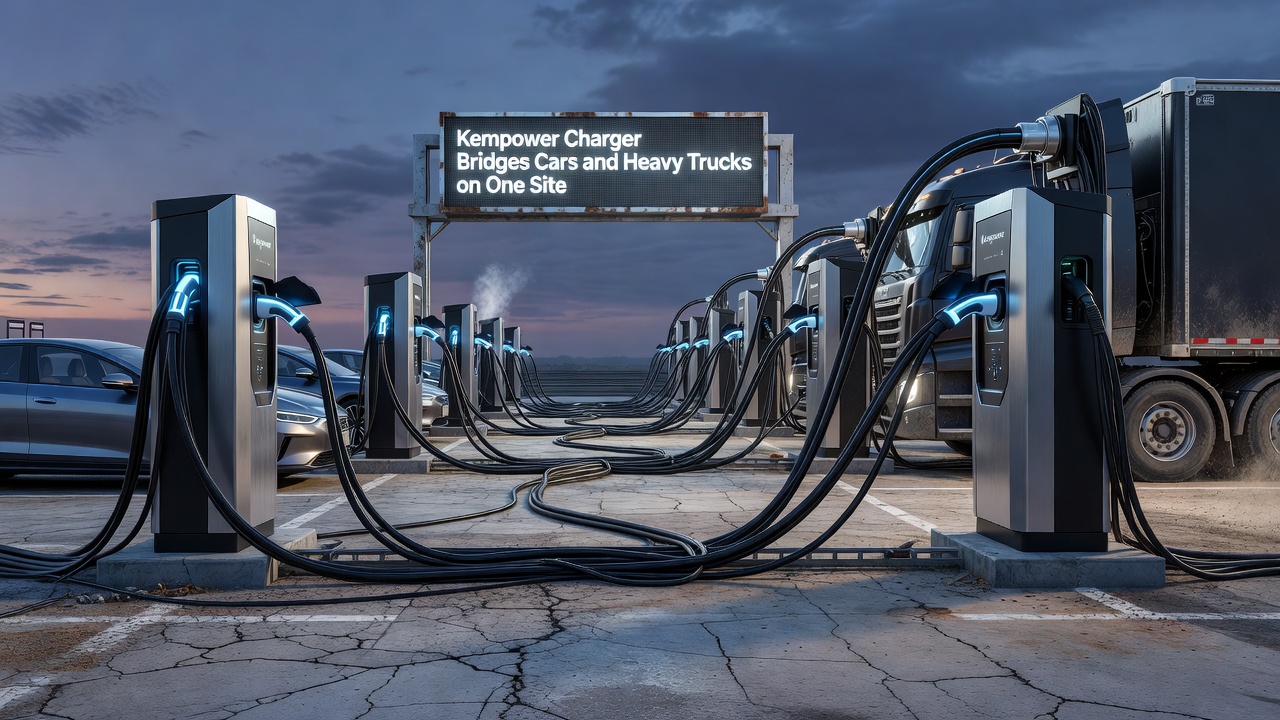
Kempower has introduced the Mega Satellite Flex, a charging dispenser built to serve both passenger electric vehicles and heavy-duty electric trucks from the same unit. The device supports the established CCS standard at up to 560 kW and the emerging Megawatt Charging System (MCS) at up to 1.2 MW, making it the Finnish company's first product to straddle both standards. It was unveiled at the Unplug & Recharge event held during ACT Expo, where it remains on display this week.
The announcement lands at a pivotal moment for charging infrastructure. CCS has been the workhorse connector for electric cars for years, while MCS is only now being deployed to meet the far higher power demands of electric trucks and buses, which need to recharge quickly during limited rest stops. Building separate sites for each vehicle class has been the default approach, but it doubles land use, permitting, and grid connection costs. Just as travelers researching digital tools often want to understand what jurisdiction means for a VPN before committing to a service, fleet operators now have to weigh which charging standard, or combination of standards, will serve them best over the next decade.
The technical case for combining CCS and MCS in a single dispenser rests on flexibility. The Mega Satellite Flex handles up to 700 amps for CCS and 1,500 amps for MCS, with cable lengths of 5 meters for CCS and 2.7 meters for MCS. That range covers everything from a compact electric hatchback to a fully loaded long-haul truck, without requiring a driver to search for a different bay. Kempower has also built in support for 800-volt vehicle architectures, an increasingly common feature in newer EVs that allows for faster charging when paired with compatible hardware.
An integrated payment terminal option rounds out the package, letting site operators offer walk-up charging without a separate kiosk. Because the unit is compatible with Kempower's existing distributed charging architecture, operators already running Kempower equipment can add the Mega Satellite Flex without rebuilding their power distribution or software systems from scratch.
Charging hardware is only as valuable as the traffic it attracts. A site that can serve both cars and trucks captures a wider customer base immediately, rather than waiting for truck volumes to justify a dedicated MCS buildout later. That distinction matters financially: high-power charging equipment is expensive, and idle dispensers erode the return on that investment. By supporting both standards from installation, operators gain a hedge against uncertain adoption timelines for MCS while still serving today's CCS-equipped fleet.
The heavy-duty trucking sector is still early in its transition to electric power, and standards bodies continue refining MCS specifications even as manufacturers begin production. Positioning a single charger to serve both eras of that transition reduces the risk of stranded assets if truck electrification accelerates unevenly across regions.
Kempower expects the Mega Satellite Flex to reach the North American and European markets in July 2026. That timeline gives fleet operators, logistics companies, and charging network developers over a year to plan deployments around the unit's arrival, and it signals that Kempower views the car-truck convergence as a near-term commercial opportunity rather than a distant bet.